Seismic engineering in Athlone addresses the critical need to design and assess structures for earthquake resilience, even in a region traditionally considered low-seismicity. This category encompasses a suite of specialised geotechnical and structural services that evaluate ground motion hazards, soil behaviour under cyclic loading, and advanced protective systems. For a growing midlands hub like Athlone, with its strategic transport corridors, pharmaceutical plants, and data centres, integrating seismic considerations into new developments and retrofits is not just prudent but increasingly a requirement of modern building codes and insurer expectations.
The local geology of Athlone is dominated by Carboniferous limestone bedrock, often overlain by glacial tills, alluvial gravels, and occasional peat deposits along the River Shannon floodplain. While bedrock generally provides favourable foundation conditions, the variability in superficial deposits creates pockets where seismic wave amplification or ground failure could occur. Lenses of soft, saturated silts and sands near the river are particularly relevant when assessing long-period shaking effects or potential for soil instability. Understanding this subsurface complexity is the foundation of any meaningful seismic assessment in the area.
Ireland operates under the National Annex to Eurocode 8 (IS EN 1998-1), which defines seismic hazard parameters for the country. Although Athlone falls into a low-hazard zone with a reference peak ground acceleration typically below 0.04g, the code mandates seismic design for structures in consequence classes CC2 and CC3, which include schools, hospitals, large commercial buildings, and critical infrastructure. The 2013 Irish National Annex introduced specific adjustments to ground types and response spectra that directly influence how seismic actions are derived for sites with deep soft soil deposits, making site-specific studies essential rather than relying on default assumptions.
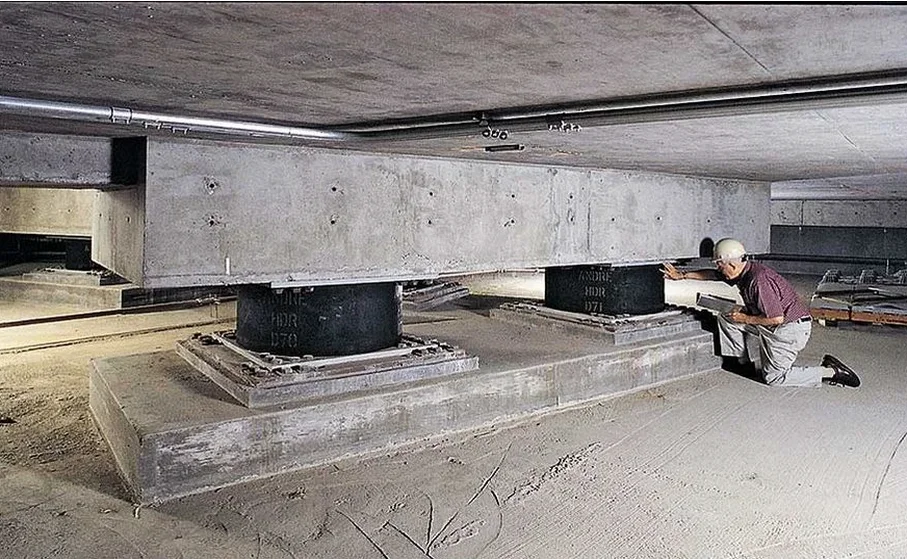
Projects that most commonly trigger the need for seismic services in Athlone include multi-storey commercial developments, industrial facilities with sensitive equipment, bridge and culvert replacements on national roads, and energy infrastructure such as substations and wind farm control buildings. For critical facilities, a base isolation seismic design approach can decouple the structure from ground motion, significantly reducing demands on structural elements. Where a site’s ground profile is variable, a seismic microzonation study provides block-by-block hazard mapping to guide land-use planning and foundation design. In riverside or reclaimed areas, a soil liquefaction analysis becomes indispensable to verify that saturated granular layers will not lose strength and cause foundation failure during a seismic event.
Frequently asked questions
Is seismic design really necessary for buildings in Athlone given Ireland's low earthquake hazard?
Yes, for certain structures it is mandatory under the National Annex to Eurocode 8. While Athlone has low seismicity, consequence class CC2 and CC3 buildings—such as schools, hospitals, and large public venues—must be designed for seismic actions. Additionally, clients and insurers increasingly require seismic resilience for business continuity, making a site-specific assessment valuable even when not strictly mandated by code.
What ground conditions in Athlone most affect seismic performance?
The key factors are the presence of soft alluvial silts, saturated sands, and peat layers overlying the limestone bedrock. These soft deposits can amplify ground motion at certain frequencies and, in the case of loose saturated sands near the Shannon, may be susceptible to liquefaction. A thorough ground investigation with shear wave velocity profiling is essential to classify the site correctly per Eurocode 8 ground types.
How does Eurocode 8 apply to the retrofitting of existing buildings in Athlone?
Eurocode 8 Part 3 (IS EN 1998-3) provides a framework for the assessment and retrofitting of existing structures. When a building undergoes a change of use, major renovation, or extension that increases its consequence class, a seismic evaluation is triggered. The code allows for performance-based approaches, meaning the retrofit level can be calibrated to the building's importance and the owner’s risk tolerance, avoiding a blanket 'full code' upgrade.
What is the difference between a standard seismic hazard assessment and seismic microzonation?
A standard assessment uses regional hazard maps and a single ground type for the site. Seismic microzonation goes further by mapping variations in ground response across a larger area, accounting for changes in soil thickness, stiffness, and topography. For a development spread over variable ground, such as a campus or industrial park in Athlone, microzonation identifies which zones may experience higher shaking and guides targeted foundation or isolation strategies.