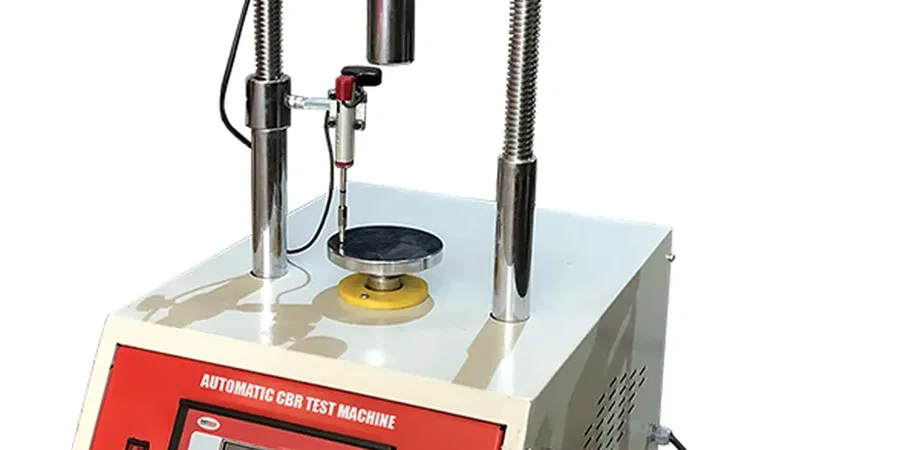
Athlone sits right in the middle of Ireland, straddling the Shannon and carrying the weight of a growing logistics hub. The N6 and M6 corridor sees constant heavy goods vehicle traffic, so any pavement design here needs to account for real loading, not just textbook values. A Laboratory CBR test gives you that: a direct measure of subgrade strength for road layers and foundation platforms. We run the California Bearing Ratio test in our accredited lab on both soaked and unsoaked samples, following the TII specification for roadworks. For sites near the callows where ground conditions get tricky, we often pair the CBR test with a Proctor test to nail the optimum moisture content before compaction. The CBR value then feeds directly into layer thickness design per the NRA TD 26/07 methodology, something our team has applied across Athlone, Moate, and Ballinasloe for years.
Soaked CBR values in Athlone's glacial till often drop below 5%, making a capping layer essential before placing subbase.
Service characteristics in Athlone
Risks and considerations in Athlone
The Midlands climate hits soil strength hard. Athlone gets around 900 mm of rain a year, and the water table across the Shannon floodplain sits just a metre or two below ground in many spots. If you skip a soaked Laboratory CBR test and design with a dry value, you're building a pavement on borrowed time. The subgrade saturates over winter, the CBR drops, and the road base starts pumping fines up through the asphalt. We've seen it on industrial estates in Garrycastle where the pavement failed within three years. Testing at the correct moisture condition, and verifying the material with a Proctor test to set the compaction target, is the only way to get the design right. The CBR test also flags swelling potential: if the sample heaves more than 2% during the soak, you need to treat or replace that material.
Our services
The CBR test is not performed independently. The following procedures are typically conducted concurrently with it for pavement projects in Athlone.
Soaked and Unsoaked CBR
The full test per IS EN 13286-47, including 96-hour soak with swell monitoring. We deliver the CBR at both penetration depths, plus a swell curve over time.
CBR with Proctor Correlation
We compact the CBR sample at the Proctor optimum and at ±2% moisture to give you a strength-moisture envelope. Essential for Athlone's moisture-sensitive glacial till.
Combined CBR and PSD Package
One sample, both tests. We run the grain size analysis on the CBR material after penetration to classify it per the TII Specification for Road Works Series 600.
Frequently asked questions
How much does a laboratory CBR test cost in Athlone?
A standard laboratory CBR test with 96-hour soak runs between €100 and €210 per sample, depending on whether you need just the CBR or the full package with Proctor correlation and particle size distribution. Three-point Proctor correlation adds a bit more. We quote per job, not per sample, so you get a fixed price upfront.
How long does a CBR test take?
The soaking period alone is 96 hours per the standard. Add sample preparation, compaction, and penetration testing, and you're looking at 5 to 6 working days from receiving the sample to the final report. If you need a faster result, we can run an unsoaked CBR in 24 hours, but that's only viable for granular materials above the water table.
Do I need soaked or unsoaked CBR for my Athlone project?
For any pavement in Athlone, soaked CBR is the default. The Shannon floodplain and high rainfall mean the subgrade will eventually saturate. An unsoaked test on glacial till gives an artificially high number. The TII pavement design method assumes a soaked CBR value, and designing with a dry CBR leads to under-designed pavement layers that rut and crack within a few winters.