Geotechnical laboratory testing forms the cornerstone of reliable ground investigation across Athlone and the wider Midlands region. This category encompasses the full spectrum of physical and mechanical tests performed on soil and rock samples recovered from boreholes, trial pits and in-situ sampling campaigns. From basic classification tests to advanced strength and compressibility assessments, laboratory analysis transforms raw field data into the engineering parameters that underpin foundation design, earthworks specification and groundwater control. In Athlone’s evolving construction landscape, where residential schemes, commercial developments and infrastructure upgrades intersect with complex glacial deposits, accurate laboratory data is not merely a technical requirement — it is a risk management imperative.
The geological context of Athlone is dominated by Quaternary glacial and glaciofluvial deposits overlying Carboniferous limestone bedrock. The River Shannon and its associated alluvial corridors introduce layers of soft, compressible silts and peats that present significant challenges for shallow foundation systems. Glacial tills of varying density and composition mantle much of the area, often interbedded with lenses of water-bearing sand and gravel. These heterogeneous ground conditions demand a rigorous approach to laboratory characterisation. Tests such as grain size analysis (sieve + hydrometer) are essential for distinguishing cohesive from granular behaviour and predicting drainage characteristics, while consolidation testing informs settlement predictions in Athlone’s soft alluvial zones.
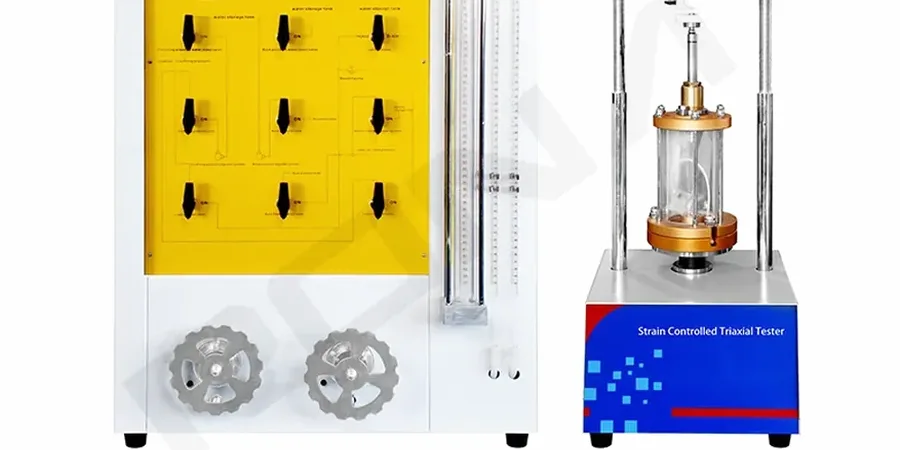
Irish laboratory testing practice operates within the framework established by Eurocode 7 (IS EN 1997-2:2007), which mandates a structured approach to ground investigation and laboratory test specification. The National Annex for Ireland, together with the guidance provided in the Institution of Engineers of Ireland (Engineers Ireland) publications and the UK Specification for Ground Investigation (frequently referenced in Irish practice), defines minimum testing frequencies and quality control standards. Accreditation to ISO 17025 is the expected benchmark for commercial geotechnical laboratories serving Athlone projects. This regulatory environment ensures that all classification tests, including Atterberg limits, bulk density and moisture content determinations, are performed to reproducible standards that satisfy both planning authority requirements and the technical demands of Chartered Engineers.
The range of projects requiring comprehensive laboratory testing in Athlone is broad. Residential developments on greenfield sites underlain by glacial till routinely require particle size distribution and plasticity testing to validate bearing capacity assumptions. Infrastructure schemes along the Shannon corridor, including flood defence works and bridge foundations, depend on triaxial compression tests and in-situ permeability correlations to assess both strength and seepage regimes. Road construction projects administered by Westmeath County Council typically specify CBR testing and moisture condition values derived from laboratory compaction studies. Even smaller commercial extensions can encounter unforeseen ground conditions where rapid classification testing prevents costly over-design or construction delays.
Available services
Frequently asked questions
What types of geotechnical laboratory tests are typically required for a site investigation in Athlone?
The testing schedule depends on the ground conditions encountered, but a typical Athlone investigation includes moisture content, Atterberg limits, particle size distribution by sieving and hydrometer, bulk density, and unconfined compressive strength on cohesive soils. Where soft alluvial silts or peats are present, oedometer consolidation tests become critical. Granular deposits often require permeability assessments, while limestone bedrock may need point load testing and petrographic description to confirm rock mass quality.
How do Irish standards influence geotechnical laboratory testing procedures?
Irish practice follows Eurocode 7 (IS EN 1997-2) which sets out the requirements for laboratory testing as part of geotechnical investigation. The National Annex provides country-specific parameters. Laboratories performing tests for Athlone projects should hold ISO 17025 accreditation, and test methods align with the IS EN ISO 17892 series. Engineers Ireland guidance and the UK Specification for Ground Investigation are also commonly referenced to ensure consistency in sample handling, testing frequency and reporting formats.
Why is laboratory testing important for construction projects on glacial soils in the Athlone area?
Athlone’s glacial and glaciofluvial deposits are inherently variable, with abrupt transitions between dense till, loose sand lenses and soft silt layers. Laboratory testing quantifies this variability in engineering terms — providing stiffness, strength and consolidation parameters that field descriptions alone cannot deliver. Without this data, foundation designs risk being either unconservative, leading to excessive settlement, or overly conservative, resulting in unnecessary cost. Testing also supports groundwater control design by characterising permeability contrasts.
How are laboratory test results used in foundation design for Athlone structures?
Laboratory-derived parameters such as effective cohesion, friction angle and constrained modulus are direct inputs to bearing capacity and settlement calculations. Consolidation test data defines the magnitude and rate of settlement under load, which is particularly relevant for Athlone’s compressible alluvial soils. Classification test results inform decisions on ground improvement viability, while permeability data feeds into dewatering system design. The results allow engineers to select appropriate foundation types — from shallow pads on stiff till to piled solutions penetrating through soft deposits to bedrock.