Ground improvement in Athlone encompasses a suite of geotechnical techniques designed to enhance the engineering properties of soil and fill materials, enabling safe and economical construction. As the town continues to expand along the River Shannon and into its hinterlands, developers frequently encounter soft alluvial clays, loose silts, and historical made ground that are incapable of supporting modern structures without treatment. This category covers the assessment, design, and verification of methods that increase bearing capacity, reduce settlement, and mitigate liquefaction risk, ensuring that foundations, roads, and infrastructure perform reliably over their design life.
The geological setting of Athlone is dominated by the River Shannon floodplain, where post-glacial deposits of soft, normally consolidated silts and clays overlie glacial tills and Carboniferous limestone bedrock. The western fringes of the town transition into cutover raised bogs and areas of marginal land with thick peat deposits, which present extreme compressibility and low shear strength. These challenging ground conditions make ground improvement not merely an option but a necessity for residential schemes, commercial parks, and the town's ongoing flood relief and road alignment projects, where conventional shallow foundations would undergo unacceptable differential settlement.
All ground improvement works in Ireland must comply with the current suite of Eurocodes, notably IS EN 1997-1:2005 (Eurocode 7: Geotechnical design) and IS EN 1998-5:2005 (Eurocode 8: Design for seismic resistance) as adopted by the National Standards Authority of Ireland. The execution of specific techniques is governed by IS EN 14731 for deep vibration methods and IS EN 15237 for vertical drains. The Irish Building Regulations Technical Guidance Document A also mandates that the stability of the supporting ground be verified, with the Institution of Engineers of Ireland often referencing the Specification for Ground Treatment for additional procedural rigour on Department of Housing funded schemes.
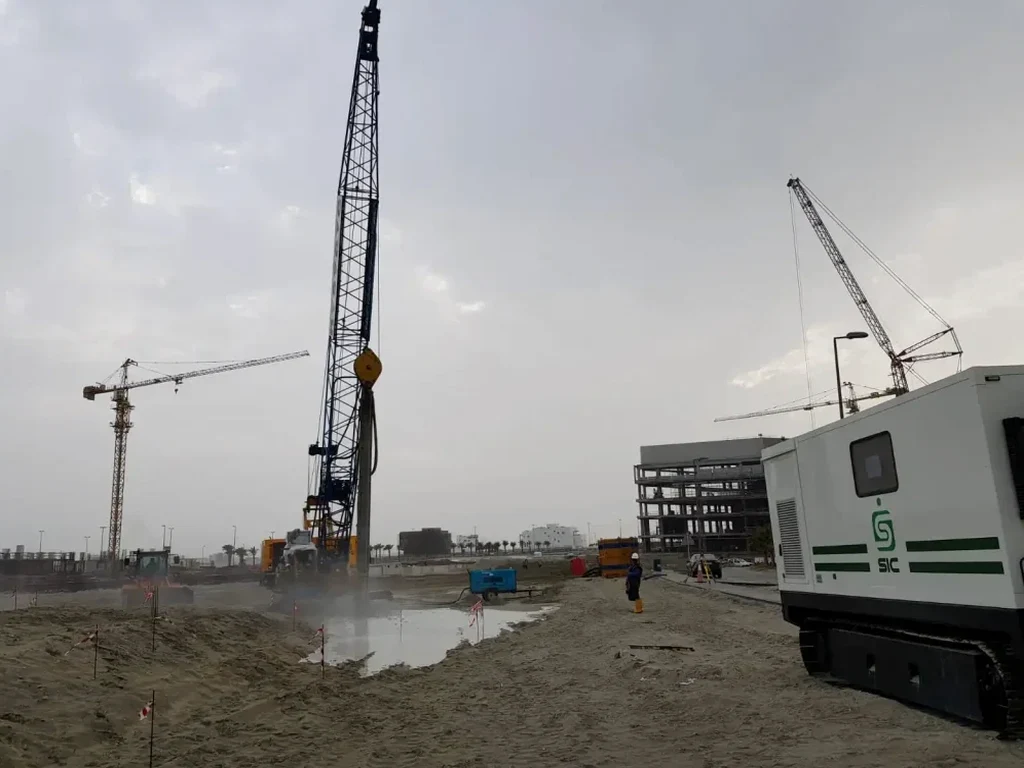
The types of projects that routinely require ground improvement in Athlone include large-footprint warehousing and logistics centres near the M6 motorway, multi-storey residential developments on brownfield sites along the river corridor, and the construction of attenuation tanks and pumping stations for the Athlone Main Drainage scheme. Road widening projects traversing peatlands and the development of sports pitches on low-lying ground also depend heavily on these techniques. For cohesive soils, the design of stone columns provides a proven solution to accelerate consolidation and reinforce the matrix, while granular deposits with insufficient density are best treated through vibrocompaction to achieve the required relative density and stiffness.
Available services
Frequently asked questions
What is ground improvement and when is it needed instead of deep foundations?
Ground improvement modifies the in-situ soil mass to increase its strength, stiffness, and drainage characteristics without removing it. It is typically selected over deep piling when the compressible layer is relatively shallow, the load is spread over a wide area, or the project budget favours treating the ground volumetrically to support conventional footings and floor slabs directly.
Which ground improvement methods are most suitable for the soft alluvial soils found along the River Shannon in Athlone?
For the soft silts and clays of the Shannon floodplain, vibro-replacement methods such as stone columns are highly effective as they create stiff, draining inclusions that accelerate consolidation and transfer load to the competent glacial till beneath. Where granular lenses exist, vibrocompaction can densify the loose sands and gravels to prevent settlement and liquefaction.
How do Irish and European standards regulate the design and testing of ground improvement works?
Design is governed by Eurocode 7 (IS EN 1997-1) which requires a limit state approach, considering both ultimate and serviceability conditions. Execution standards like IS EN 14731 for deep vibration dictate the quality control procedures. Post-treatment verification typically involves CPT, plate load tests, or zone load tests to confirm that the specified acceptance criteria, such as a minimum stiffness modulus, have been achieved.
What site investigation data is essential to design a reliable ground improvement scheme in Athlone?
A comprehensive investigation must delineate the thickness of the soft alluvium and peat, the depth to glacial till or bedrock, and the groundwater regime. High-quality data from cone penetration tests with pore pressure measurement, combined with laboratory oedometer and triaxial tests on undisturbed samples, are critical to calibrate the settlement and bearing capacity models used in the treatment design.