A three-storey mixed-use development near the Golden Island shopping area hit refusal during piling at less than 2 metres — dense gravel over soft, peaty silt that simply could not take the load without lateral displacement. That is the reality of building in Athlone, where the River Shannon and its tributaries have laid down metres of compressible alluvium across much of the town centre and western suburbs. Rather than excavate thousands of cubic metres of unsuitable material, the design team opted for a grid of vibro-replacement stone columns extending through the weak zone to reach competent bearing strata at roughly 6 to 7 metres depth. When the CPT test profile shows tip resistances below 0.5 MPa for several consecutive metres, stone columns become one of the most practical ground improvement strategies available. The method densifies the surrounding soil while creating stiff, vertical drainage paths — essential in a town where the water table often sits just a metre below street level.
In Athlone’s floodplain silts, a stone column grid can halve total settlement while cutting foundation costs compared to a fully piled solution.
Service characteristics in Athlone
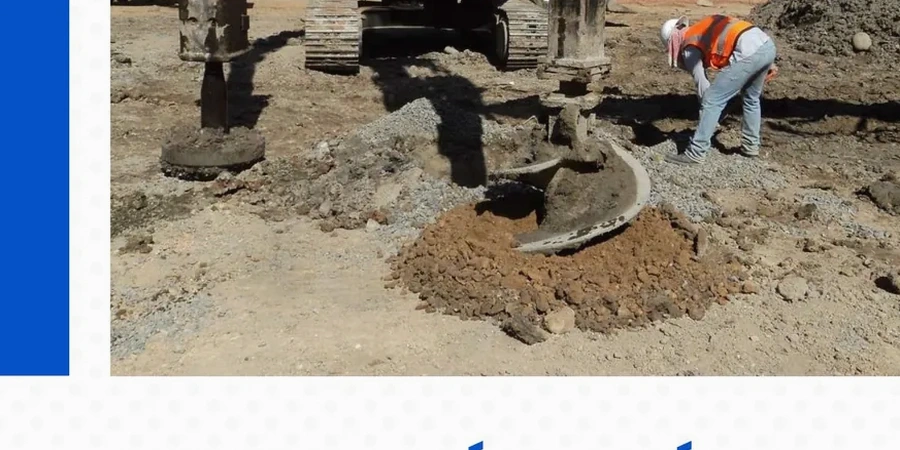
Risks and considerations in Athlone
Sites in the town centre and along the Deerpark Road corridor sit on a sequence of laminated clays and peats that can vary in thickness by over two metres across a single building footprint. By contrast, ground conditions improve noticeably toward the eastern side of the N55 approach, where glacial till appears closer to the surface and the soil is more amenable to shallow footings. The risk in the central and western zones is not just total settlement but differential movement, which is notoriously difficult to predict when peat lenses are present. Stone columns mitigate this by transferring load through the weak horizon and distributing stress into the surrounding soil, but the design must account for the possibility of organic layers compressing unevenly over time. Without a thorough site investigation — including at least two boreholes for a residential plot and more for commercial structures — column lengths can be miscalculated, leaving untreated pockets that become settlement hotspots. The engineering team in Athlone takes a conservative approach, always designing for the worst-case stratigraphic profile encountered within the site perimeter.
Our services
The ground improvement work we coordinate in Athlone covers the full project cycle, from initial feasibility assessment through to post-installation verification. Each phase is handled by specialist subcontractors operating under the supervision of an experienced geotechnical engineer familiar with Shannon basin deposits.
Feasibility and Preliminary Design
Review of site investigation data to determine whether stone columns are viable for the specific Athlone ground profile. Includes assessment of column diameter, depth, and grid geometry based on loading requirements and settlement tolerances.
Installation Supervision and QA/QC
On-site monitoring during vibroflot installation, recording penetration rate, amperage, and backfill consumption per column. Post-installation verification using CPT profiling at column centres and midpoints to confirm achieved stiffness.
Performance Validation and Settlement Monitoring
Design and execution of plate load tests on selected columns, combined with longer-term settlement monitoring using precise levelling points cast into the ground-bearing slab or pile caps.
Frequently asked questions
What ground conditions in Athlone make stone columns necessary?
Much of Athlone’s central and western development land sits on soft alluvial silts and peat layers deposited by the River Shannon. These soils typically show undrained shear strengths below 25 kPa in the upper 4 to 6 metres, which is insufficient for strip or pad footings carrying moderate structural loads. Stone columns bypass this weak zone by creating stiff, load-bearing columns that also accelerate drainage and consolidation.
How do stone columns compare to piling for a typical Athlone residential project?
For buildings up to about four storeys on Athlone’s floodplain soils, stone columns often provide a more cost-effective solution than driven or bored piles. They distribute the structural load across a wider composite ground mass rather than concentrating it at discrete pile points, which can be advantageous when dealing with variable peat layers. The choice depends on the specific load requirements and the depth to competent bearing strata.
What is the typical cost range for stone column design and installation in Athlone?
For a standard small to medium-sized project in Athlone, the combined design and installation cost for a stone column ground improvement scheme generally falls between €1,220 and €4,080, depending on the treated area, column depth, and grid density required. A site-specific quotation is always prepared after reviewing the ground investigation report.
How long does installation and verification testing take on an Athlone site?
For a typical residential or light commercial plot in Athlone, the vibroflot rig can install 30 to 50 columns per day. The entire ground improvement phase, including mobilisation, installation, and post-treatment CPT verification, usually takes between 3 and 7 working days. Curing time is not required, so foundation construction can begin immediately after sign-off.