Athlone’s strategic position in the heart of Ireland, straddling the River Shannon, has shaped its development from an early medieval crossing point into a key logistics and manufacturing hub for the Midlands. The underlying geology here transitions between Carboniferous limestone and alluvial deposits from the Shannon’s floodplain, creating a patchwork of ground conditions that demand careful seismic consideration. While Ireland sits in a region of low seismic hazard, the national annex of Eurocode 8 (I.S. EN 1998-1:2005) still requires a design peak ground acceleration of 0.04g for a 475-year return period. For critical infrastructure such as pharmaceutical plants, data centres, and the regional hospital, a performance-based approach using base isolation seismic design is not just prudent — it becomes a rational engineering choice. The team integrates site-specific hazard assessment with advanced seismic microzonation studies to refine the ground motion inputs for Athlone’s variable soil profile, ensuring the isolation system is tuned to real subsurface behaviour rather than generic code spectra.
Base isolation in Athlone reduces inter-storey drifts by 60-80% compared to fixed-base structures, transforming seismic demand into a controlled displacement problem at the isolation plane.
Service characteristics in Athlone
Risks and considerations in Athlone
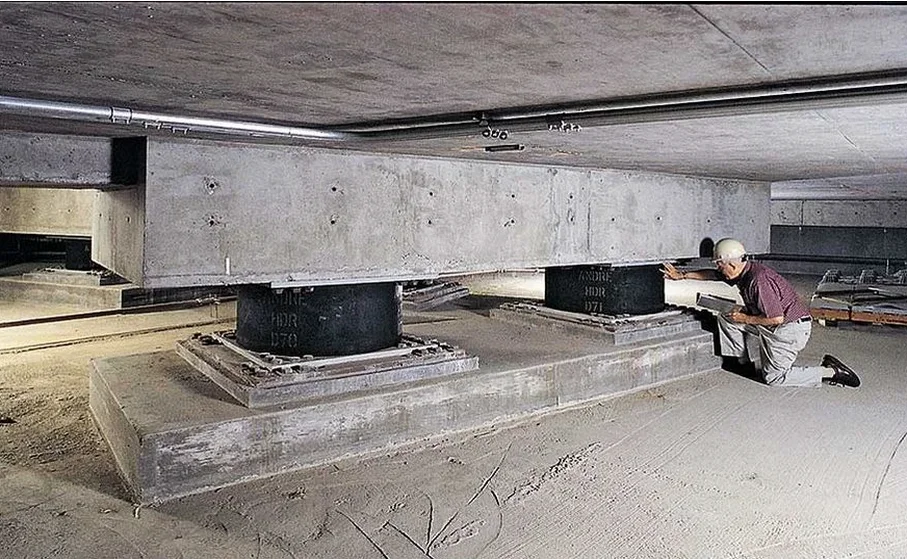
A six-storey commercial building designed with fixed-base assumptions on Athlone’s Class D alluvial soils may experience spectral accelerations amplified by a factor of 1.8 to 2.2 in the 0.2–0.5 second period range — precisely where many mid-rise structures sit. The risk is not collapse in the traditional sense, but rather non-structural damage and business interruption, which can carry higher financial consequences than structural repairs. Pharmaceutical cleanrooms, for instance, tolerate very low floor accelerations; even moderate shaking can compromise sterile environments. During a design review for a facility west of the M6, the non-isolated option showed excessive residual drifts under the 475-year event. The integration of a seismic isolation system shifted the fundamental period to 2.9 seconds, cutting the base shear demand by a factor of three. The moat wall was detailed with a compressible fill to absorb the 270 mm design displacement without transferring impact loads into the basement walls — a detail verified through explicit gap-element modelling in the non-linear analysis.
Our services
The application of base isolation seismic design in Athlone encompasses multiple structural typologies and performance objectives. The following services constitute the standard sequence from feasibility assessment through detailed design and prototype testing.
Non-Linear Time-History Analysis (NLTHA)
Site-specific analysis using Athlone-matched ground motion suites (minimum 7 pairs) to capture the hysteretic behaviour of HDRB and LRB isolators under MCE-level shaking.
Isolator Prototype and Production Testing
Full-scale testing programs per I.S. EN 15129 Annex B, including ageing, creep, and scragging recovery tests on isolators destined for Midlands construction sites.
Performance-Based Design for Critical Facilities
Design briefs targeting Immediate Occupancy (IO) or Operational (OP) performance levels for Athlone's healthcare and pharmaceutical manufacturing sectors.
Moat Wall and Utility Crossing Detailing
Design of flexible service connections and moat covers to accommodate 300+ mm displacement demands without compromising fire separation or waterproofing integrity.
Frequently asked questions
Is base isolation seismically justified in a low-hazard area like Athlone?
Yes, when the performance objective goes beyond life safety. For critical facilities such as data centres and pharmaceutical plants in Athlone, the cost of business interruption and equipment damage often exceeds the isolation premium. The design PGA of 0.04g is an elastic reference; soil amplification on Class D sites can raise spectral ordinates significantly, making isolation a cost-effective resilience measure.
What is the typical cost range for a base isolation system in Athlone?
For a medium-scale building in Athlone (2,000–4,000 m² footprint), the supply, testing, and installation of an elastomeric isolation system typically falls between €3,540 and €6,680 per isolator, depending on diameter, lead core specification, and testing protocol. A full system with 20–30 units and moat detailing is priced accordingly.
How do Athlone's soil conditions affect the isolation design?
The transition from limestone bedrock to Shannon alluvial deposits creates a stiffness contrast that can amplify long-period motion. We run site-specific response analyses to capture this effect, verifying that the isolation period does not coincide with the fundamental site period. Where soft clays are present, the CPT testing results feed directly into the soil-structure interaction model.
Which building types in Athlone benefit most from base isolation?
Buildings with sensitive contents or high operational continuity demands — pharmaceutical cleanrooms, server farms, regional hospital wings, and emergency response centres. In Athlone, the medical device manufacturing sector, concentrated around the Blyry and IDA industrial estates, presents a strong case for isolation of vibration-sensitive production lines.