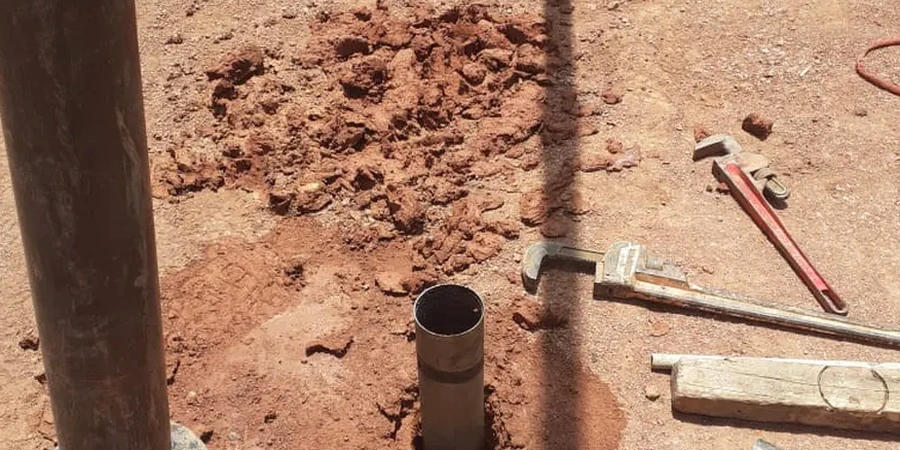
Athlone sits squarely on the banks of the Shannon, where water is never far from the conversation. The river shapes the town in obvious ways, but what lies beneath the surface matters just as much for anyone breaking ground. Glacial tills and alluvial deposits dominate the substrate, and their permeability can shift dramatically over short distances. We run Lefranc tests in granular soils and Lugeon tests in fractured limestone bedrock to measure hydraulic conductivity directly in the field. A test pit gives visual confirmation of the strata before we place the packer, and in mixed profiles we often combine the Lefranc method with grain size analysis to correlate field results with lab-derived estimates. Without this data, dewatering plans and foundation drainage are guesswork.
A Lugeon value of less than 1 indicates tight, low-conductivity rock; above 15, expect significant water ingress during excavation.
Service characteristics in Athlone
Risks and considerations in Athlone
Athlone's medieval core grew around the ford, but modern development pushes into low-lying ground near the Shannon floodplain and onto glacial till slopes east of the town. Builders who skip permeability testing often find themselves with flooded excavations or undersized sump pumps. More critically, seepage pressures behind retaining structures can build up without warning. We have seen projects where a Lefranc test revealed k-values two orders of magnitude higher than lab estimates from disturbed samples, completely changing the dewatering strategy. For deeper basements and deep excavations near the river, ignoring in situ hydraulic conductivity means designing for groundwater conditions that simply do not match reality.
Our services
Our field permeability services in Athlone cover the full testing cycle, from borehole preparation to final interpretation.
Lugeon Packer Testing in Rock
Five-stage pressure test in NQ or larger boreholes. We isolate the test interval with pneumatic packers, apply stepped pressures, and record flow until steady state. Results classify rock mass permeability from very tight to highly conductive, with commentary on fracture behaviour.
Lefranc Permeability in Soils
Constant-head or variable-head test in granular and cohesive soils. We measure rate of water flow or recovery over time to derive the coefficient of permeability k. Direct input for dewatering design and seepage analysis.
Frequently asked questions
When is a Lugeon test required instead of a Lefranc test?
Lugeon applies to fractured rock where the flow is dominated by discontinuities. If the borehole advances into limestone, sandstone, or granite with visible joints, a packer test is needed. Lefranc is for soils and very weathered rock where the medium is more porous and less fractured.
What does the price range cover for in situ permeability testing in Athlone?
Field permeability testing in Athlone ranges from €620 to €1010, depending on the number of test intervals, borehole depth, and whether it is a Lefranc or Lugeon configuration. Mobilisation and packer setup are included in that range.
How long does a single Lugeon test take?
A five-stage Lugeon test typically takes 60 to 90 minutes per interval, including packer inflation, pressure stabilisation at each stage, and deflation. Complex fracture networks or high flow rates may extend the duration.
Can you test permeability in existing monitoring wells?
Yes, provided the well is constructed with a suitable diameter and the screen section is known. We can perform variable-head Lefranc-type tests in monitoring wells, but dedicated test sections in fresh boreholes give more reliable Lugeon results.