The glacial till underlying much of Athlone’s east side presents a completely different design scenario than the soft alluvial clays found along the Shannon’s western floodplain. Bearing capacity here can swing from 150 kPa to below 75 kPa within a single site, and that variability dictates everything about the shallow foundation approach. Our team has logged hundreds of boreholes across Westmeath and Roscommon, and the pattern is consistent: weathered limestone bedrock sits under a mantle of lodgement till, but river terrace gravels and post-glacial silts create lenses that standard desk studies often miss. For larger footprints, we pair the design with CPT testing to map these soft inclusions before finalising the bearing stratum, avoiding the differential settlement that plagues poorly investigated sites near the old Athlone rail corridor. BS 8004:2015 and IS EN 1997-1:2005 provide the framework, but local stratigraphy writes the final specification.
Allowable bearing pressure on Athlone glacial till is not a constant — it is a function of matrix composition, water table position, and loading eccentricity validated through site-specific investigation.
Service characteristics in Athlone
Risks and considerations in Athlone
The Shannon’s winter flood regime introduces a hydraulic gradient that erodes fine particles from the soil matrix, and that changes the long-term stiffness under a shallow footing more than most engineers assume. When the river level drops in spring, the rapid drawdown can shift the effective stress state enough to trigger consolidation settlement in normally consolidated silts that appeared stable during the dry summer investigation. We account for this by running settlement analyses under two extreme groundwater scenarios: the measured winter high and the recorded summer low. The difference in predicted settlement between these two states often exceeds 10 mm, which is significant for masonry-clad structures. On sites within 200 metres of the riverbank, we specify deeper key-in into the gravel layer or request that the stone columns ground improvement option be evaluated as a contingency if the till cover proves thinner than the borehole log suggests.
Our services
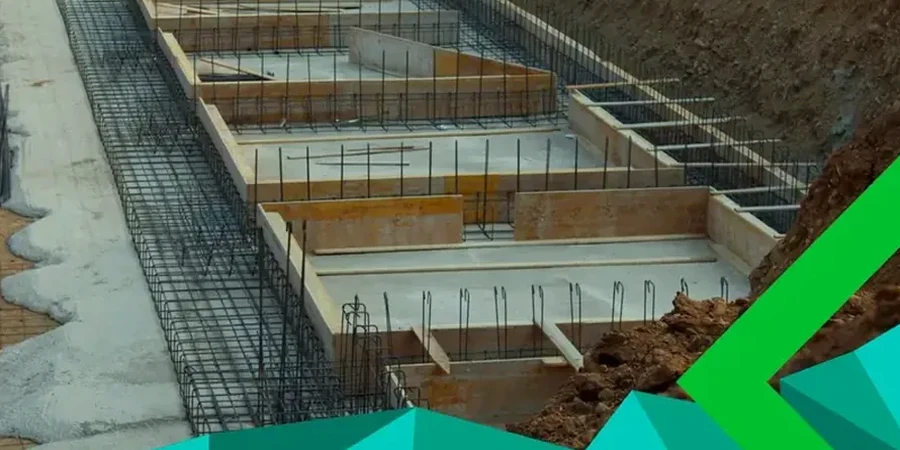
Shallow foundation design in Athlone moves through three distinct phases: site characterisation, geotechnical parameter derivation, and structural-geotechnical interface design. Each phase draws on a specific set of field and laboratory procedures calibrated for Irish glacial soils.
Bearing capacity verification
Analytical bearing capacity calculation using Brinch Hansen’s method with partial factors from the Irish National Annex. We incorporate undrained shear strength from triaxial testing and drained friction angles from direct shear box tests on reconstituted samples.
Settlement analysis
Immediate and consolidation settlement prediction using oedometer-derived constrained modulus profiles. We model load spread through layered profiles with Burland and Burbridge’s method, reporting total and differential settlement against project-specific tolerance criteria.
Ground improvement integration
When the shallow bearing stratum is marginal, we design the transition to improved ground: compacted granular replacement layers, geogrid-reinforced pads, or vibro-replacement columns. The shallow foundation geometry is then optimised for the improved modulus profile.
Frequently asked questions
What is the minimum depth for a shallow foundation in Athlone’s glacial till?
Typically 600 mm below finished ground level to bypass the desiccated crust and seasonal moisture fluctuation zone. However, on sites with mature tree cover in Athlone’s older residential areas, the NHBC Chapter 4.2 guidance applies, and we often specify 900 mm minimum depth to account for clay shrinkage potential.
How much does a shallow foundation design package cost for a single dwelling?
For a standard single-dwelling project in Athlone, the shallow foundation design package — including bearing capacity calculation, settlement analysis, and a foundation layout drawing — typically ranges from €1,880 to €3,070, depending on the complexity of the ground profile and the number of load cases to verify.
Do you need a site investigation before designing a shallow foundation?
Absolutely. BS 5930:2015 specifies a minimum of two investigation points for a single dwelling, but in Athlone’s variable glacial terrain we recommend at least three to capture lateral variability in the till matrix and to identify any soft alluvial pockets that could compromise bearing performance.
What is the difference between a strip footing and a raft foundation?
A strip footing supports linear loads under walls and is the most common shallow foundation for residential construction on competent till. A raft foundation spreads the load over the entire building footprint and is specified when the bearing stratum is weaker or when differential settlement must be minimised — common on the alluvial silts west of Athlone town centre.
How long does settlement take to complete under a shallow foundation in Athlone soils?
Immediate elastic settlement occurs during construction. Consolidation settlement in the low-permeability glacial till and alluvial clays around Athlone typically takes 3 to 12 months to reach 90% completion, depending on drainage path length and the presence of silt or sand laminations that accelerate pore pressure dissipation.