Underground excavations in Athlone encompass a broad range of geotechnical engineering activities focused on the safe and efficient creation of subterranean spaces. This category covers everything from the initial ground investigation and design phases through to construction monitoring for tunnels, basements, utility corridors, and deep foundations. Given Athlone's strategic position on the River Shannon and its growing urban infrastructure, understanding the complexities of excavating below ground is critical for the longevity and safety of both new developments and historic structures.
The local geology presents a unique challenge, dominated by glacial till and alluvial deposits overlying Carboniferous limestone bedrock. The soft, water-bearing soils along the Shannon floodplain are particularly notorious for their low shear strength and high compressibility. This makes specialist geotechnical analysis for soft soil tunnels an essential service, as standard excavation methods often fail in such conditions. Furthermore, the limestone bedrock can be karstified, introducing risks of sudden ground collapse and unpredictable water ingress that must be carefully managed from the outset of any project.
Adherence to Irish and European standards is non-negotiable for all underground works. The primary framework is Eurocode 7 (EN 1997), specifically its Part 1 on general geotechnical design and Part 2 on ground investigation, implemented in Ireland with the National Annexes. The execution of these works must follow the relevant parts of EN 1990 and the execution standard IS EN 13670. Crucially, the Health and Safety Authority (HSA) enforces stringent regulations for working in confined spaces and excavations under the Safety, Health and Welfare at Work (Construction) Regulations 2013, requiring robust temporary works designs and continuous monitoring.
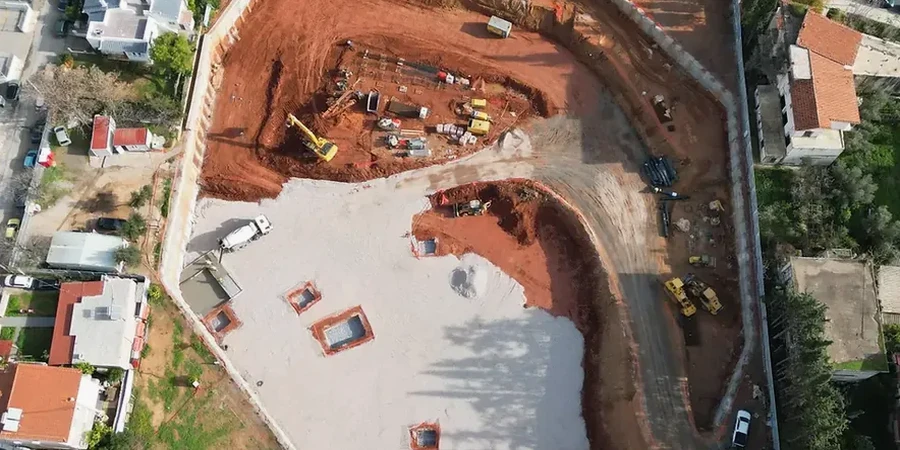
The types of projects that demand this expertise are diverse across the Midlands region. Urban regeneration schemes often require deep basements for parking and services, necessitating a precise geotechnical design of deep excavations to protect adjacent buildings. Infrastructure upgrades, such as new drainage tunnels or the Athlone Main Drainage Scheme, rely entirely on advanced tunnelling techniques. Even for smaller commercial developments near the town centre, the installation of deep pile foundations or underground storage tanks requires a thorough understanding of ground behaviour to prevent settlement and structural damage.
Frequently asked questions
What are the main geotechnical risks of underground excavation in Athlone's soil conditions?
The primary risks stem from the soft, saturated alluvial clays and silts, which can lead to basal heave, face instability in tunnels, and excessive settlement behind retaining walls. The potential for encountering karst features in the underlying limestone adds a significant risk of sudden water inflow and ground collapse, requiring comprehensive site investigation to mitigate.
Which Irish regulations govern the safety of deep excavation works?
Safety is governed by the Safety, Health and Welfare at Work (Construction) Regulations 2013, enforced by the HSA. These mandate a specific design for temporary works, including trench supports and shoring, and require a competent person to inspect excavations regularly. Eurocode 7 provides the design basis to ensure stability.
What is the difference between a top-down and bottom-up deep excavation method?
A bottom-up method involves excavating the full depth and then constructing the permanent structure upwards from the base slab, often requiring extensive temporary strutting. The top-down method constructs the permanent top-level floor slab first, which acts as a strut, and excavation proceeds beneath it, allowing the above-ground structure to be built simultaneously, which is often faster in urban areas.
Why is continuous monitoring critical during underground excavation projects?
Continuous monitoring provides real-time data on ground movement, vibration, and water pressure, allowing engineers to verify design assumptions and detect early warning signs of instability. This is crucial in Athlone to protect adjacent historic properties and infrastructure from damage, triggering immediate mitigation actions if predefined trigger values are exceeded.