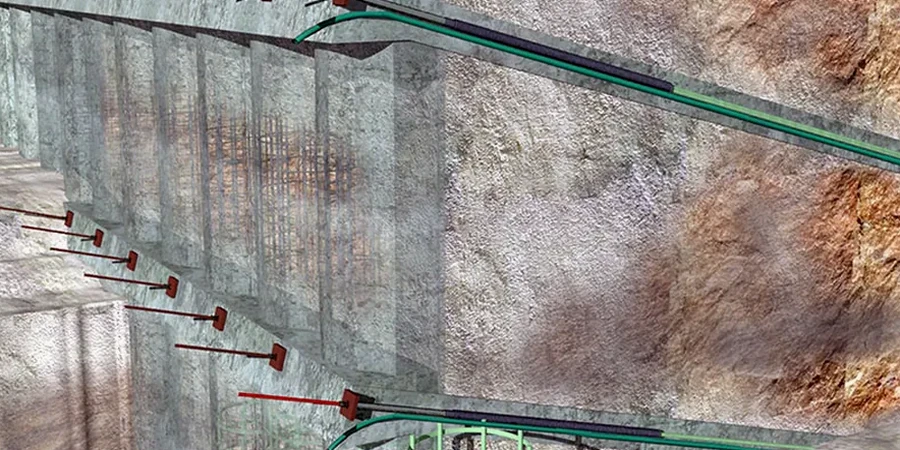
Hydraulic jacks pressurize a multi-strand tendon inside a borehole drilled into Athlone's glacial till. That is the moment an active anchor locks in its design load. Passive anchors work differently. They mobilize resistance only when the ground moves. Both systems rely on a fixed length grouted into competent material. In Athlone, the subsurface alternates between limestone bedrock and dense boulder clay left by the last glaciation. The River Shannon adds a high water table across much of the town centre. These conditions demand anchor bond lengths calculated with precision. Our team verifies grout-to-ground bond values with in-situ permeability tests before finalizing the design. Every anchor is proof-tested on site to confirm it meets the specified lock-off load.
An anchor is only as reliable as the ground that holds it. In Athlone's glacial deposits, bond length is never guessed. It is calculated.
Service characteristics in Athlone
Risks and considerations in Athlone
A commercial development on the west bank of the Shannon near Custume Place required a 6-metre deep excavation. The contractor assumed a standard anchored sheet pile wall would be sufficient. The designer specified active anchors at 2-metre spacing. During proof testing, three anchors failed to reach 80 percent of the design load. The grout had flowed into an undocumented solution cavity in the limestone. The fixed length was effectively halved. The project lost three weeks while the anchor pattern was redesigned with longer bond zones and inclined differently to intersect more competent rock. Groundwater added complexity: the tendon free length corroded where the sheathing was nicked during installation. The remedial cost exceeded the original anchor package by a factor of four. That site now has a permanent dewatering system and a monitoring programme that checks anchor loads quarterly.
Our services
Anchor design in Athlone covers three distinct applications. Each requires a different approach to bond length, corrosion protection and testing.
Active pre-stressed anchors
Designed for permanent retaining structures and dam tie-downs where immediate load transfer and strict deformation control are required. Proof-tested to 1.5 times the service load on site.
Passive reaction anchors
Used in temporary excavations and slope stabilization where ground movement is acceptable. Engages resistance through deformation. Cost-effective for short-term works.
Anchor load testing and monitoring
On-site suitability tests, proof tests and long-term monitoring with load cells. Verifies design assumptions and detects load loss from creep or corrosion.
Frequently asked questions
What is the difference between active and passive anchors?
Active anchors are tensioned to a specified lock-off load immediately after installation. They apply a compressive force to the structure from the start. Passive anchors are not pre-stressed. They develop resistance only when the retained soil or structure begins to move, making them a reaction system rather than a pre-load system.
How much does anchor design and testing cost in Athlone?
Anchor design packages in the Athlone area typically range from €820 to €3,040 depending on the number of anchors, the required bond length verification and the testing programme. A full package includes geotechnical review, anchor geometry drawings, grout specifications and on-site proof testing supervision.
What ground conditions in Athlone affect anchor performance the most?
The limestone bedrock beneath Athlone can be karstified with voids and solution features that reduce grout confinement. The glacial till above it is dense but variable. A high water table near the Shannon requires careful consideration of borehole stability during drilling and long-term corrosion protection for permanent anchors.
How long does it take to install and test a ground anchor?
A single anchor installation including drilling, tendon placement, grouting and stressing typically takes one day. Proof testing adds another day for the grout to reach sufficient strength. A full anchor programme on a typical Athlone retaining wall excavation runs two to three weeks including all suitability and acceptance tests.